
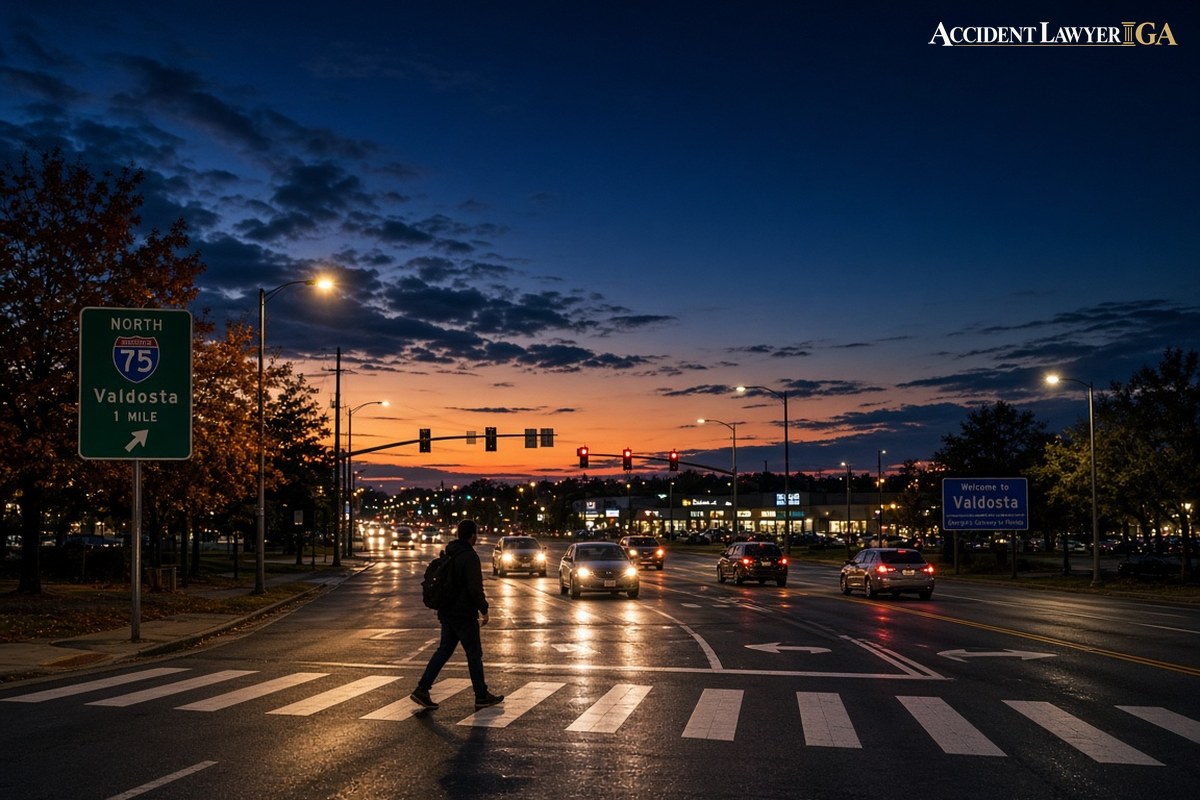
On Sunday, November 1, 2026, clocks in Georgia move back one hour as daylight saving time ends. The change sounds small. On the road, it is not. The evening drive home, the walk from a parking lot, the school pickup, the trip to a night shift, and the drive along Interstate 75 through Valdosta now happen in darker conditions, while sleep schedules and daily routines are still adjusting. A trip that felt bright and familiar in late October can feel completely different during the first week of November.
For drivers, passengers, cyclists, and pedestrians in Valdosta, Lowndes County, and across South Georgia, the weeks after the time change call for extra care. This guide explains why darker evenings change crash risk, which collisions happen most often in low light, what Georgia law requires of drivers and pedestrians, what evidence can disappear quickly, and the exact steps to take if you or someone you love is hurt. It also explains how insurance companies use darkness and comparative fault after a crash, and when it makes sense to speak with a Georgia accident lawyer.
Why darker evenings change the risk
Visibility is only part of the problem. After the time change, three things happen at the same time, and together they create a difficult period on Georgia roads.
First, the evening commute moves into darkness. People who were driving home in daylight are suddenly driving at dusk or after dark. Headlights, glare from oncoming traffic, wet pavement, and shadows change how quickly a driver can see a person in a crosswalk, a cyclist at the edge of a lane, a child near a parked car, or a stopped vehicle ahead. Depth perception is weaker at night, and a driver may recognize a hazard later than they would have during the day.
Second, routines are out of sync. Sleep is disrupted for many people in the days after a time change. Even losing or gaining one hour can affect alertness, reaction time, and judgment. A tired driver is more likely to drift within a lane, brake late, miss a traffic signal, roll through a stop, or fail to check a blind spot before turning. Fatigue can also make a driver less patient in heavy traffic, which increases the chance of a rushed left turn or a close follow.
Third, pedestrians keep the same schedule. Students, workers, shoppers, church groups, sports teams, and families are still out at 6 p.m. and 7 p.m. The people on foot did not change their plans. The light around them changed. A pedestrian who was easy to see at 6:30 p.m. in October may be standing in shadow at the same time in November.
That mix - darker streets, tired drivers, and the same evening foot traffic - is why Georgia families should treat the weeks after November 1 as a higher-risk season on city streets, rural highways, parking lots, school zones, and neighborhood roads alike.
The short version: Slow down at dusk, turn headlights on early, look twice at intersections, and give people on foot extra time and space. If a crash happens, photograph the light conditions the same night and get medical care before you debate fault with an insurance company.
What changes on Valdosta and South Georgia roads
Valdosta drivers deal with a mix of local streets, commercial corridors, school traffic, university traffic, and interstate traffic. A driver may leave a neighborhood street, cross a busy multi-lane road, and merge onto I-75 within a few minutes. Each environment presents a different darkness problem.
On a commercial corridor, the problem is visual clutter. Store lights, signs, turning vehicles, buses, and people walking from parking lots compete for a driver's attention. A pedestrian between parked cars may be visible for only a second. On a neighborhood street, the problem may be the opposite: fewer lights, darker shoulders, mailboxes and parked cars close to the road, and children or dog walkers who expect drivers to be moving slowly. On a rural Lowndes County road, there may be no crosswalk, no sidewalk, and very little shoulder, while traffic moves much faster.
Interstate driving brings another set of risks. Trucks and cars travel at high speed, following distance shrinks quickly when traffic slows, and a tired driver has less time to react to brake lights. A crash that begins as a rear-end collision can become a multi-vehicle collision in seconds. Darkness also makes debris, disabled vehicles, and people outside a vehicle harder to see.
Crashes we see in darker conditions
Evening crashes are not limited to one kind of collision. The same visibility and fatigue problems can lead to very different claims, and the evidence needed can vary by crash type.
Rear-end crashes
A driver who is tired, distracted, or following too closely may not realize traffic has stopped until it is too late. Low light can make brake lights blend into signs and storefront lighting. The driver in front may be blamed unfairly for stopping suddenly, when the real problem was speed, distance, or inattention behind them. Photographs of the roadway, traffic flow, vehicle positions, and damage can help reconstruct what happened. Learn how these claims are handled on our Georgia car accidents page.
Left-turn and intersection crashes
Intersections require a driver to judge gaps, watch signals, check crosswalks, and look for oncoming traffic at the same time. At dusk, a driver may focus on other cars and miss a pedestrian or cyclist crossing with the signal. A rushed left turn is especially dangerous because the turning driver is often looking through glare while the person crossing is in shadow.
Pedestrian crashes
Pedestrian crashes can happen in marked crosswalks, unmarked intersections, parking lots, school areas, apartment complexes, and along roads without sidewalks. The injuries are often severe because a person on foot has no vehicle frame, seat belt, or airbag for protection. Head injuries, fractures, spinal injuries, and internal injuries can occur even at speeds a driver may describe as slow.
Bicycle and motorcycle crashes
Cyclists and motorcyclists are smaller, narrower, and easier to lose in glare or shadow. A driver changing lanes or turning may look directly toward a rider and still fail to register what they saw. Reflective gear and lights help, but they do not remove a driver's duty to keep a proper lookout.
Truck and commercial vehicle crashes
Truck crashes involve longer stopping distances, larger blind spots, and more complex evidence. A fatigued commercial driver, a poorly maintained lighting system, or a rushed delivery schedule can turn a visibility problem into a catastrophic collision. Company records, inspection history, dispatch information, and electronic vehicle data may matter in addition to the police report.
Parking lot and backing-up crashes
Not every evening crash happens at highway speed. Parking lots around stores, restaurants, schools, and medical offices are busy after dark. Drivers backing out while looking for traffic may miss a person walking behind the vehicle. Low speed does not mean no injury, especially for an older adult, a child, or a person who falls onto pavement.
Three evening crash examples
Example 1: The crosswalk the driver says they never saw. A Valdosta worker crosses a commercial street at dusk using a marked crosswalk. A driver turning left says the pedestrian came out of nowhere. The same-night investigation should look at the signal phase, street lighting, the driver's speed, phone use, headlight condition, and whether other witnesses saw the pedestrian from a different angle. The driver's statement is a starting point, not the final answer.
Example 2: The I-75 slowdown. Traffic slows suddenly after dark and a tired driver rear-ends the car ahead, pushing it into another vehicle. The injured driver is later told they stopped too quickly. Vehicle damage, event data, traffic conditions, witness accounts, and the following driver's statements can test that argument. A multi-vehicle crash may involve several insurance policies and competing versions of the first impact.
Example 3: The parking lot injury. A shopper walking behind a reversing SUV is knocked down and suffers a fractured hip. The driver says the shopper walked behind the vehicle without looking. Camera video from the store, the vehicle's backup camera and lighting, the layout of the lot, and medical records may all become important. A case can be serious even when vehicle damage is minor.
Georgia law and the evening drive
Georgia drivers have duties that matter even more after dark. Drivers must use reasonable care, obey speed limits and traffic signals, keep a proper lookout, maintain control of the vehicle, and watch for people on foot and on bicycles. Speed that might be manageable in daylight can be unreasonable in darkness, rain, glare, or heavy pedestrian traffic. A posted speed limit is a maximum, not a guarantee that the speed was safe for the conditions.
Pedestrians also have responsibilities. Georgia law addresses when pedestrians should yield, how they should cross, and the importance of obeying traffic signals where they are provided. Drivers, however, are still expected to exercise care to avoid colliding with a pedestrian. A pedestrian case is rarely decided by one fact alone.
The Georgia Hands-Free Act
Georgia's Hands-Free Act still applies in November. In general, a driver cannot hold or support a phone or electronic device with their body, write or read texts and messages while driving, or watch or record video while driving, subject to the details and exceptions in the law. A driver who is holding a phone, reading a message, or looking down at a screen in a dark intersection has even less time to react when a person steps into view. If phone use played a role in a crash, cell phone records, witness accounts, vehicle data, and video can become important evidence.
Georgia comparative fault
Fault in Georgia is not always all-or-nothing. Georgia follows a modified comparative fault rule. In general, an injured person may still recover compensation if they are less than 50 percent at fault, with the award reduced by their share of fault. If the injured person is found 50 percent or more at fault, recovery is generally barred.
Insurance companies know this rule well. After a nighttime pedestrian crash, an adjuster may focus heavily on dark clothing, the exact place the person crossed, weather, or whether the person was looking at a phone. Those facts may matter, but they do not end the inquiry. Speed, distraction, headlight condition, intersection design, lighting, driver fatigue, and whether the driver was watching the road can be just as important. Do not assume that an insurer's first fault argument is correct.
What to do at the scene
Evening crash checklist:
- Call 911 and ask for medical help and law enforcement when anyone is hurt.
- Turn on hazard lights when it is safe and move out of traffic only if you can do so safely.
- Photograph the scene before vehicles are moved when possible - streetlights, signals, crosswalk markings, headlights, skid marks, debris, and vehicle positions.
- Record a short video showing what a driver could actually see approaching the area.
- Get names, phone numbers, insurance information, and license plate numbers.
- Ask witnesses to stay long enough to give their contact information.
- Write down the direction each vehicle was traveling and the color of the traffic light.
- Do not apologize or guess about fault. Describe what you know and identify what you do not know.
Darkness is hard to recreate later. A streetlight that was out, a burned-out headlight, a dark stretch of shoulder, or glare from a sign may look very different in a daytime photograph. Same-night photos and video, taken safely, can preserve the condition that made the crash happen.
The first week after the crash
Medical care comes first. Go to the emergency room, urgent care, or your doctor as recommended, and follow up when symptoms continue. Headaches, dizziness, confusion, numbness, back pain, abdominal pain, and trouble sleeping should not be ignored. Some injuries become clearer over several days. Keep a simple daily note about pain, missed activities, sleep, medication, and work limitations. That record can help you explain how the injury affected your life after the initial shock wore off.
Report the crash to your own insurance company as required by your policy, but be measured in what you say before you know the full extent of your injuries. You can provide basic facts without guessing about fault, minimizing symptoms, or agreeing that you feel fine. Keep copies of the crash report, medical bills, discharge papers, imaging results, prescriptions, repair estimates, towing receipts, rental records, and proof of missed work.
Avoid posting about the crash on social media. A photo of you smiling at a family event does not show how you felt later that night, but an insurer may still try to use it out of context. Keep your accounts private and do not discuss the collision, your injuries, or settlement negotiations online.
Evidence that can disappear quickly
Video is often the first evidence to go. A store, apartment complex, school, or traffic system may overwrite recordings in days. Vehicle data can be lost when a car is repaired or totaled. A trucking company may have logs, inspection records, maintenance files, dispatch messages, and electronic data that need to be requested promptly. Witnesses forget details or change phone numbers. Roadway lighting can be repaired, making the scene look safer than it was on the night of the crash.
A lawyer can send preservation letters, request records, review the crash report, identify available insurance, and work with investigators or experts when the crash is complex. The sooner that process begins, the better the chance that the case will be decided on evidence instead of competing memories.
How insurance companies use darkness
An insurer may argue that a pedestrian was impossible to see, that a driver had no time to react, or that the injured person caused the crash by crossing in the wrong place. In a car crash, the insurer may argue that brake lights were unclear, the lead driver stopped suddenly, or weather made the collision unavoidable. Weather and darkness can be relevant, but they also raise a question: did the driver slow down and increase following distance for those conditions?
Quick settlement offers deserve caution. An offer made before treatment is complete may not account for future care, missed income, scarring, chronic pain, or the cost of repairing or replacing a vehicle. Signing a release usually ends the claim, even if a later diagnosis shows a more serious injury. Before accepting, make sure you understand your medical condition, your bills, and every insurance policy that may apply, including uninsured or underinsured motorist coverage.
Deadlines and why waiting can hurt a Georgia claim
Georgia injury claims are subject to deadlines. The general statute of limitations for many personal injury claims is two years, but exceptions and shorter notice deadlines can apply, especially when a government entity is involved or the claim is not a standard injury claim. A wrongful death or property damage claim may follow different rules. Do not rely on a general article to calculate your deadline.
Waiting creates practical problems even before a legal deadline arrives. Video is erased, vehicles are repaired, witnesses move, and medical gaps give insurers an argument that the injury was minor or came from something else. Speaking with counsel early does not obligate you to file a lawsuit. It gives you a chance to understand the timeline and protect the evidence while you decide.
When to call a Valdosta accident lawyer
Consider calling a lawyer promptly when someone suffered a serious injury, a pedestrian or cyclist was hit, fault is disputed, a commercial truck was involved, the other driver left the scene, more than two vehicles were involved, or an insurer is pressuring you to give a recorded statement or accept money quickly. You should also ask for help when the crash report seems incomplete or inconsistent with what you remember.
Jody D. Peterman, LLC represents clients across Georgia in personal injury and criminal defense matters from its office at 304 North Ashley Street in Valdosta. In an evening crash case, the firm can review the crash report and available video, secure photographs and records, identify insurance coverage, organize medical documentation, and deal with insurers while the injured person focuses on treatment. No lawyer can promise a result in a particular case. What counsel can do is explain the rules and deadlines that may apply, investigate before evidence is lost, and present the claim with records instead of guesses.
Frequently asked questions
Does darkness make the driver automatically at fault?
No. Darkness is a condition, not a legal conclusion. Fault depends on right of way, speed, visibility, driver attention, pedestrian conduct, vehicle condition, and the available evidence.
Can I still have a claim if I was partly at fault?
Possibly. Georgia's modified comparative fault rule generally bars recovery when the injured person is 50 percent or more at fault. Below that threshold, compensation is generally reduced by the person's share of fault.
What if I was wearing dark clothing when I was hit?
Clothing may be one fact an insurer discusses, but it does not decide the case by itself. Lighting, speed, distraction, crosswalk markings, and whether the driver kept a proper lookout also matter.
The driver says I came out of nowhere. Is my case over?
Not necessarily. That statement should be tested against video, witness accounts, vehicle data, lighting, sight lines, and the driver's speed and attention. People often describe a sudden event that evidence shows developed over several seconds.
How soon should I contact a lawyer after a Georgia crash?
As soon as you are able, especially when injuries are serious, fault is disputed, a pedestrian was hit, or a commercial truck was involved. Early action helps preserve video, vehicle data, and witness information.
What if the other driver left the scene?
Report it immediately, write down everything you remember about the vehicle and direction of travel, and look for witnesses or nearby cameras. Your own uninsured motorist coverage and other policies may also need to be reviewed.
Should I give the insurance company a recorded statement?
Be cautious. You may have duties to cooperate with your own insurer, but a recorded statement to the other driver's insurer can be used to lock in incomplete answers before you know your injuries. Ask what is required and consider getting legal advice first.
How long do I have to file a Georgia injury claim?
Many Georgia personal injury claims have a general two-year deadline, but exceptions and shorter notice rules exist. Because the correct deadline depends on the claim and the parties involved, get case-specific advice as soon as possible.
Stay visible during the darker weeks ahead
Drivers: turn headlights on at dusk, slow down in pedestrian areas, clean your windshield, replace weak headlights, and put the phone away. Increase following distance and look for people at the edges of the road, not only for other vehicles. Pedestrians: use marked crossings where available, make eye contact when possible, stay alert, and avoid assuming that a driver has seen you. Cyclists and motorcyclists should use required lights and make themselves as visible as conditions allow.
If you or a loved one was hurt in a Georgia car, pedestrian, bicycle, motorcycle, or truck crash, contact Jody D. Peterman, LLC or call 888-599-9052 to discuss the next step.
This article is general information about Georgia law, not legal advice about a specific case. Reading it does not create an attorney-client relationship. Past results do not guarantee future outcomes.